
Innoverse:
Gamifying Strategy
Designing a multi-sensory learning engine for the innovator's mindset.
Product Strategy
Game Mechanics
User Experience
Designing a multi-sensory learning engine for the innovator's mindset.
How do you *teach* an "innovator's mindset"? This was the core challenge of our graduate course. Complex academic frameworks like the UN's PRME Principles and Sustainable Development Goals (SDGs) suffer from an "abstraction gap." Students understand them intellectually but fail to internalize them emotionally.
Our challenge was to design a "conditioning program" - a product that would force users to practice the behaviors of an innovator. We moved beyond a standard board game to create Innoverse: a multi-sensory, immersive simulation. By integrating audio soundscapes, performative role-play, and collaborative mechanics, we transformed passive learning into an active, high-stakes experience. This project demonstrates how to make complex ideas simple, accessible, and engaging through strategic game design.
The assignment was to create a "conditioning program" to foster an innovator's mindset. We found a critical gap between academic knowledge and practical application. Abstract theories on responsible innovation are not "sticky" - they are passive, hard to internalize, and disconnected from real-world practice. More importantly, developing a mindset cannot be done by one-time transfer of knowledge.
Traditional educational tools rely on reading and memorization. We identified three specific user experience barriers that prevent students from truly adopting an innovator's mindset.
Frameworks like the 7 PRME Principles (Purpose, Values, Teach, etc.) are complex and difficult to memorize or apply from a lecture. A quiet classroom environment kills creative energy. Without sensory stimulation, users struggle to enter a "flow state."
Reading about innovation doesn't make you an innovator. Students lacked a "sandbox" to practice creative problem-solving and collaboration. Users felt anxious about "pitching" ideas in a raw format, leading to safe, boring solutions rather than bold innovation.
There was no existing tool that merged PRME, SDGs, and innovation principles into a single, repeatable, hands-on learning experience. Turn-based play often leads to disengagement. We needed a system where everyone is active, even when it's not their turn.
Our strategy was to translate abstract systems into tangible game mechanics. We acted as strategic designers, mapping complex theories to simple, fun, and repeatable actions to create an experiential learning "product."
We analyzed the course learning outcomes (PRME & SDGs) to identify the core behaviors we needed to elicit: rapid ideation, ethical decision-making, and resource negotiation. This resulted in a creative brief that defined our product's primary goal: create a tool that forces players to use creative methodologies and enhance collaboration. Main intention was to foster the Innovator’s Mindset that internalizes UN’s Principles of Responsible Management Education.
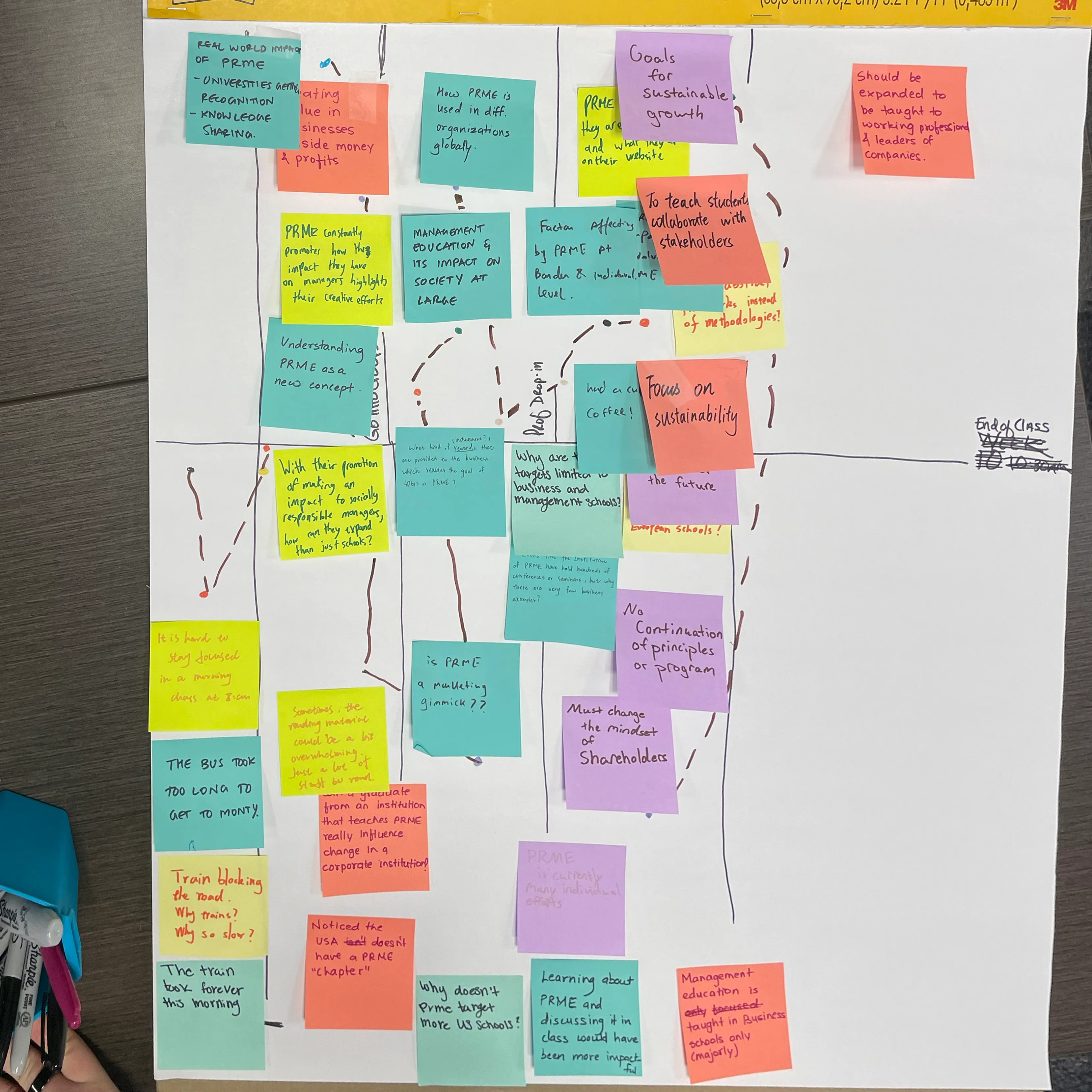
We mapped the overlaps between three abstract frameworks: The Innovator's Mindset (the goal), the 7 PRME Principles (the "how-to"), and the 17 SDGs (the "what"). We defined the essence of an Innovator’s Mindset and how it can be developed.
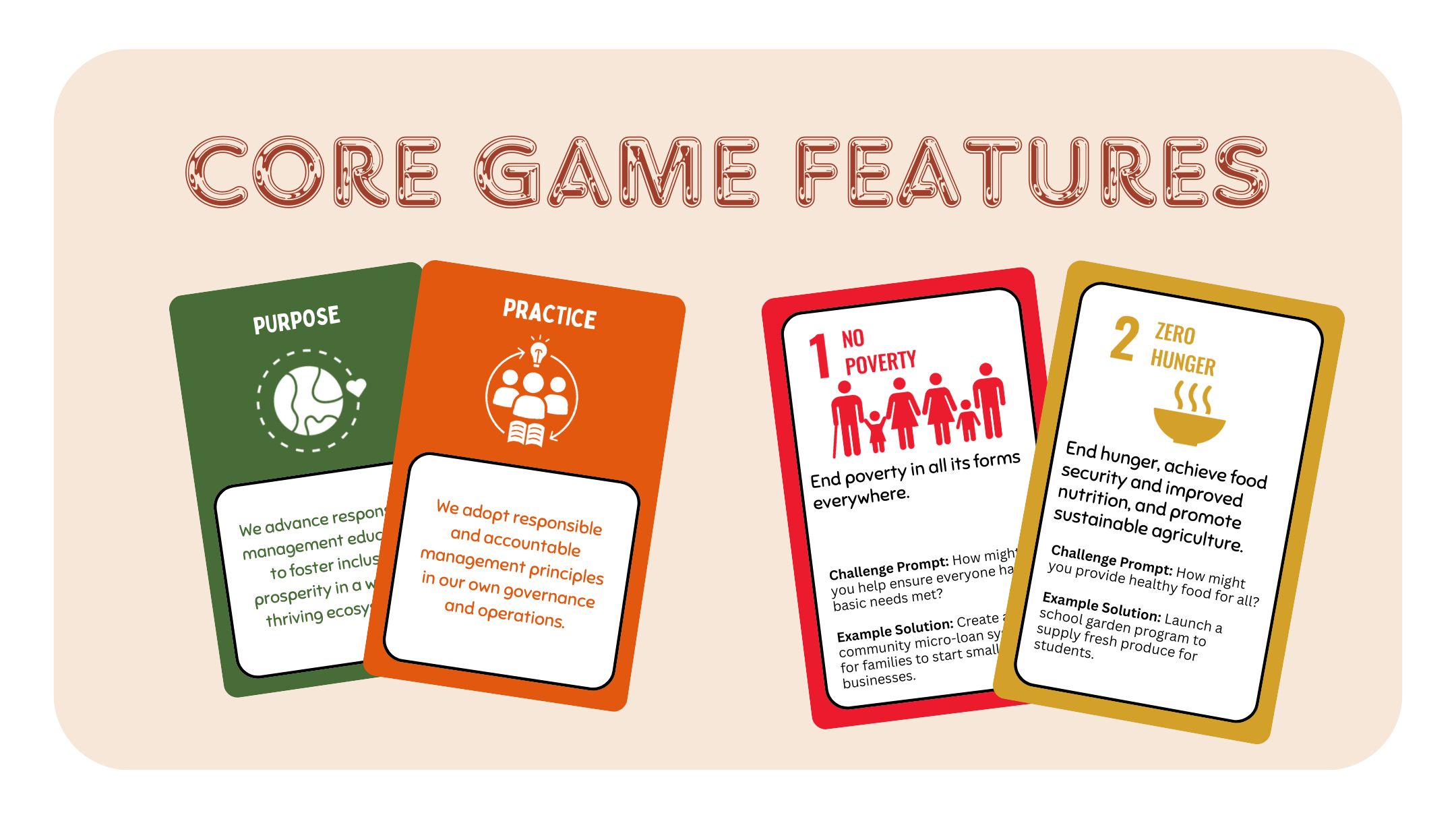
We translated our system strategy into core game mechanics. We turned each abstract principle into a concrete, playable rule or "product feature." We mapped the 17 SDGs as "Game Challenges" and the 7 PRME principles as "Action Cards." This created a clear loop: Use a Principle (Action) to solve an SDG (Challenge). We wanted this to be an immersive experience that is engaging for our target audience - university students.
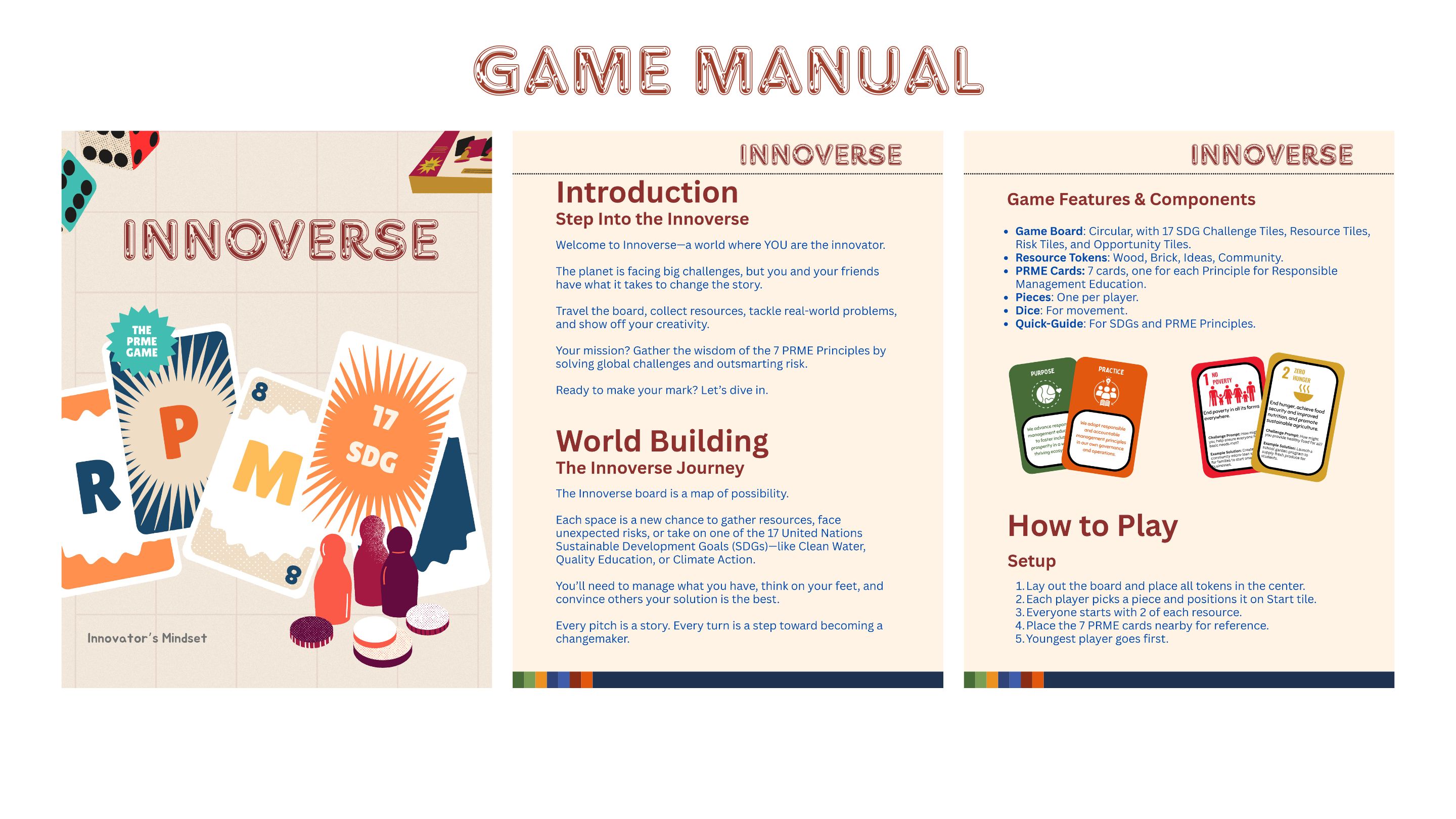
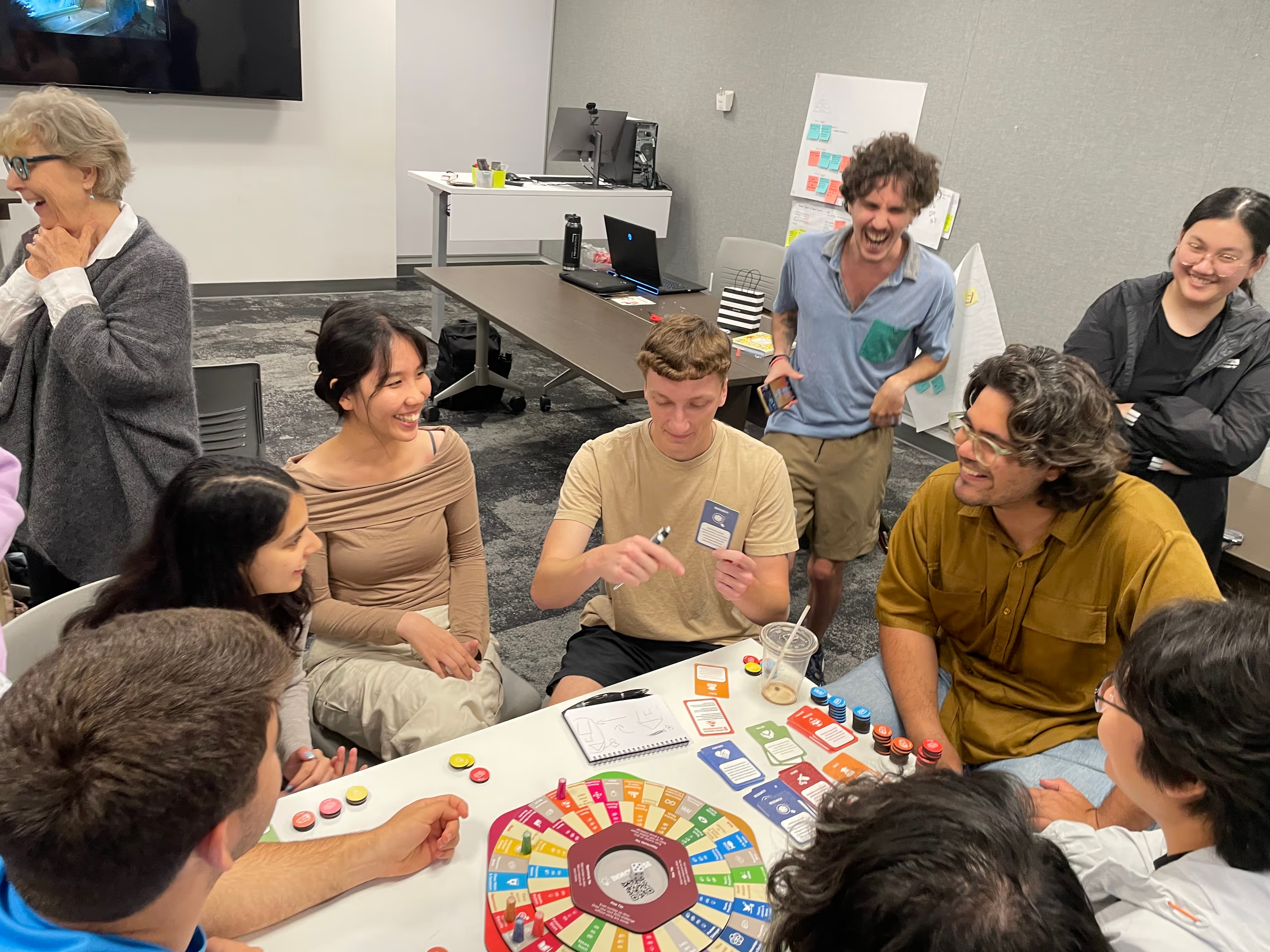
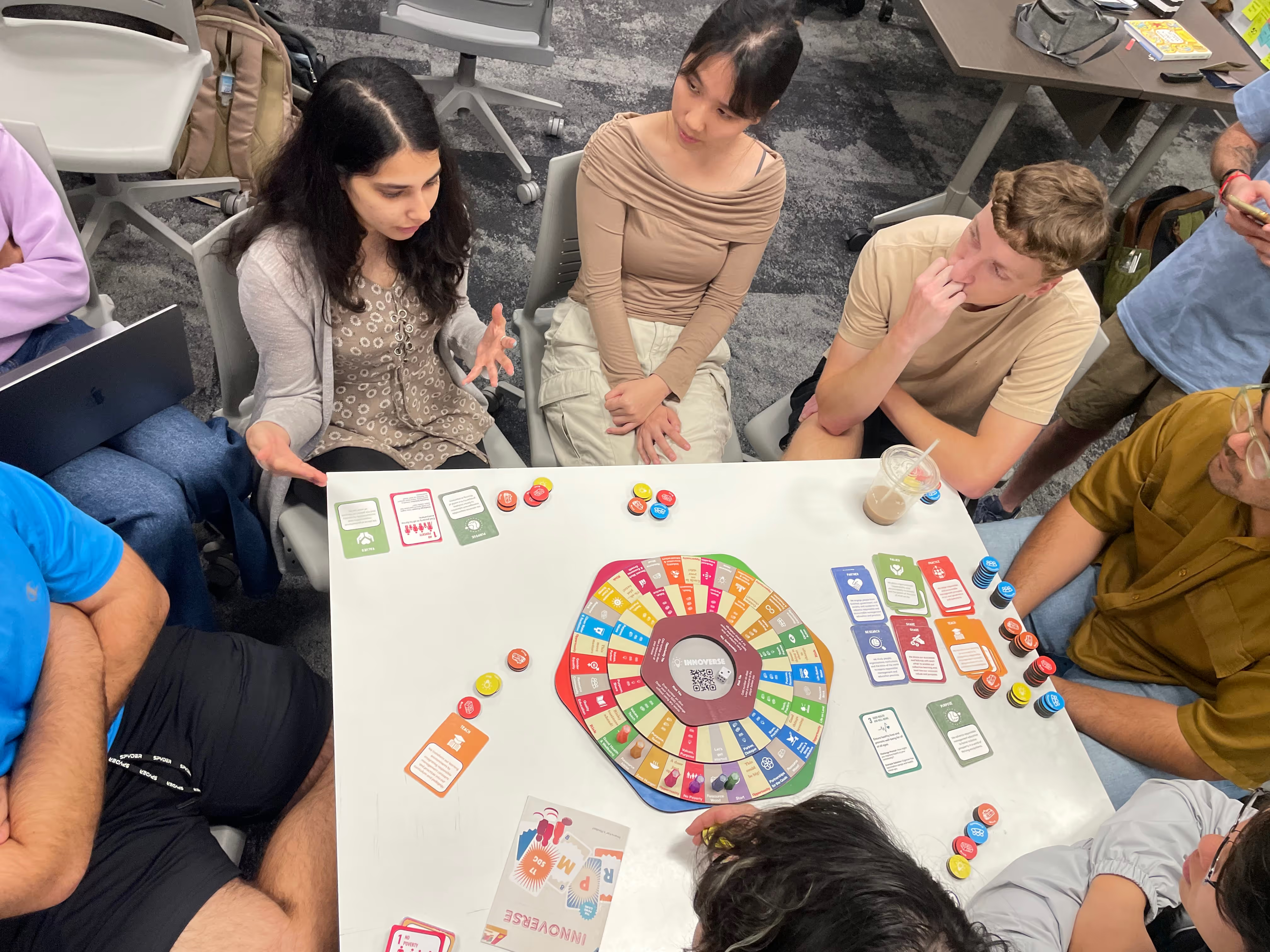
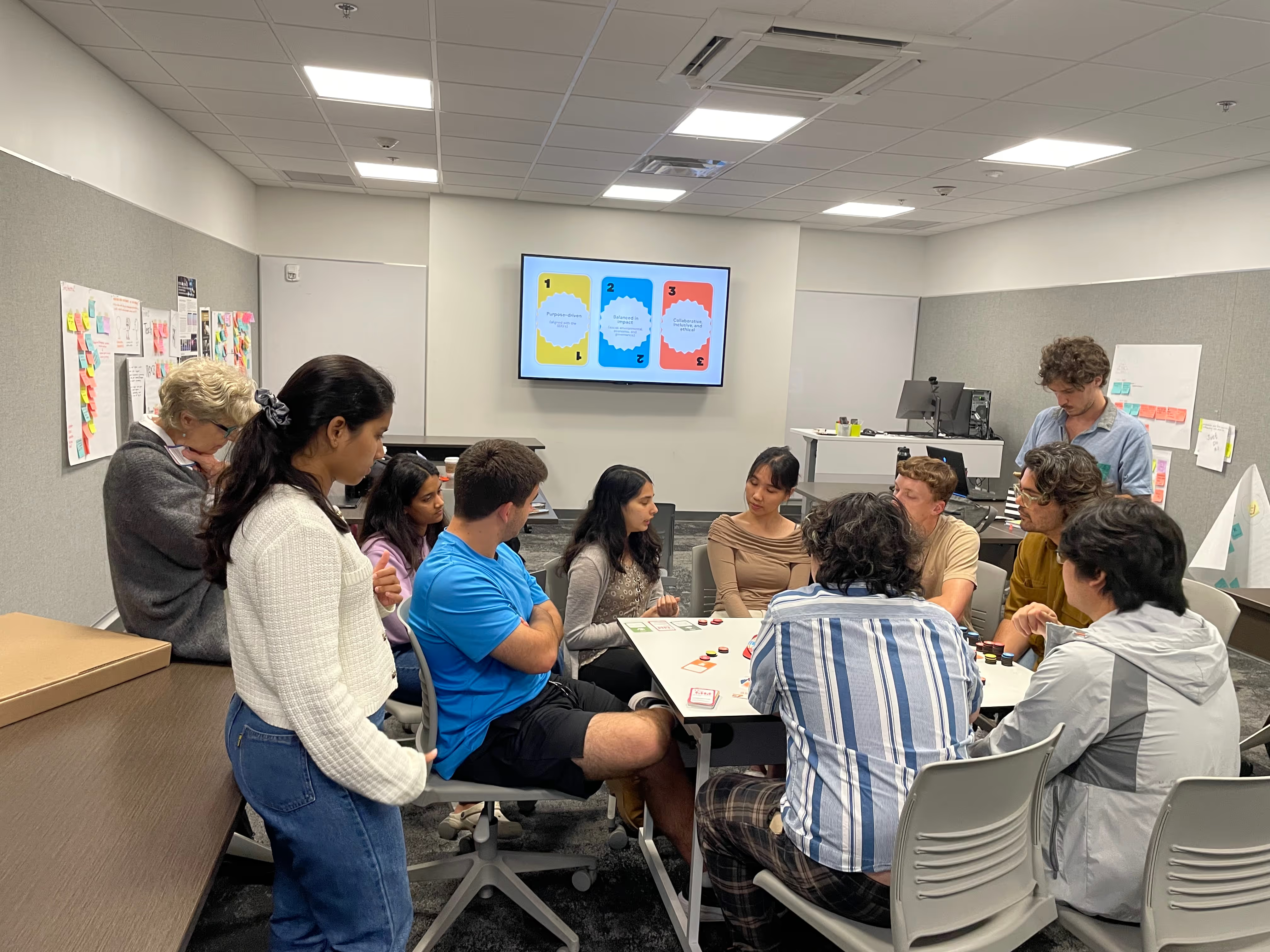
We rapidly built a low-fidelity prototype and conducted multiple playtesting sessions to validate the core game loop and player experience (PX). Based on the feedback from the tests, we refined the gameplay to simplify secondary features and modified winning strategy. Feedback also showed that while the mechanics worked, the energy was low. This pivot led to the integration of the multi-sensory audio layer.
Our strategic solution was to create a "learning engine" where game mechanics directly map to learning outcomes. This framework connects real-world problems (SDGs) with responsible innovation methods (PRME) to produce the target mindset.
The application of this learning engine was our concept of the "Innoverse" game kit. We designed "Innoverse" as a complete, tangible product - a "hackathon in a box" - that makes responsible innovation playable, collaborative, and memorable.

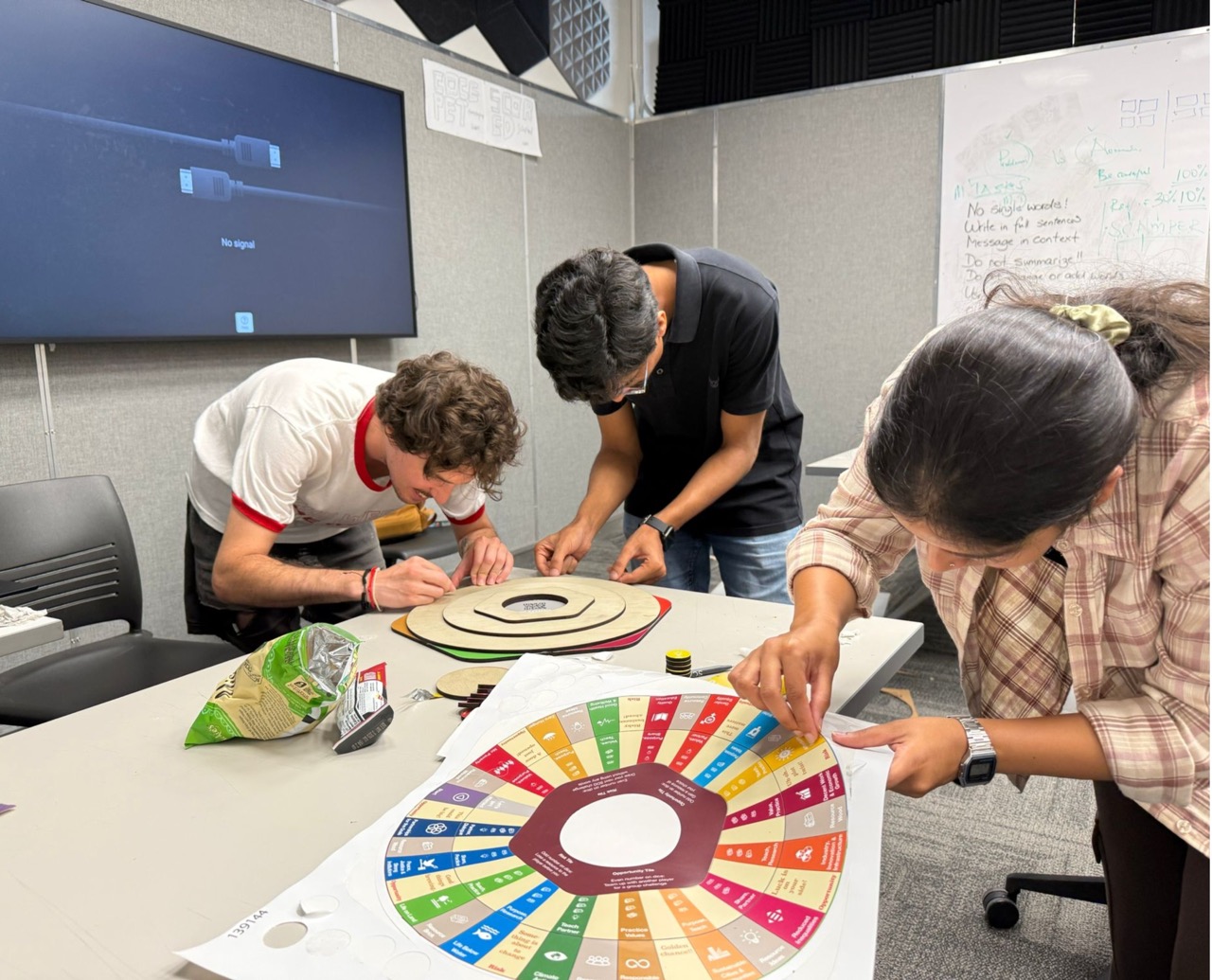
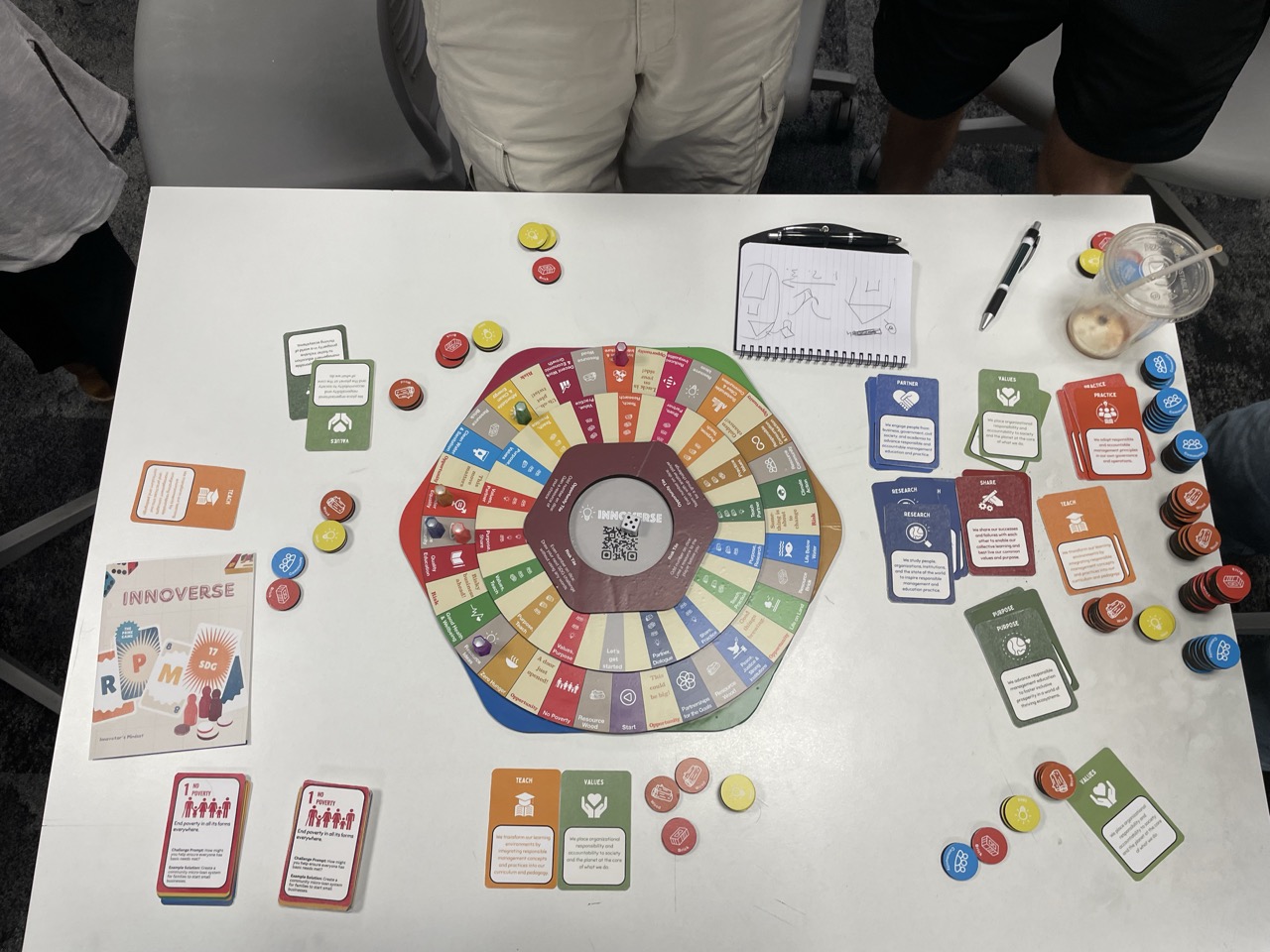
A comprehensive, multi-sensory product ecosystem designed to make innovation instinctive.
We built a custom Spotify Playlist acting as the game's "Dungeon Master."
Audio Rulebook: Reduces cognitive load by explaining rules via audio tracks making it more accessible.
Timed Soundscapes: Creates urgency during pitch rounds with rising tempo music.
To break the "fear of pitching," we introduced the "Immersive Pitch" mechanic.
The Constraint: Players cannot use words. They must ACT, DRAW, or BUILD their solution.
The Outcome: Forces lateral thinking and lowers social anxiety through shared playfulness.
We designed the resource economy to be intentionally scarce.
Resource Mapping: No single player has all the "Impact Coins" needed to solve a complex SDG.
The Result: Players *must* negotiate and partner to win, simulating real-world stakeholder management.
Innoverse" successfully translated the course's abstract learning outcomes into a highly effective "conditioning program," proving that complex strategic concepts are best learned through experience, not lecture. The final product was validated through multiple playtests with design and business students. The feedback confirmed that we successfully bridged the gap between theory and practice.
Solved for Abstract Learning
Transformed passive listeners into active innovators. Players couldn't just know the 7 PRME principles; they had to use them to win the game, internalizing the concepts through action.
Created a Safe Space to Fail
The "Immersive Pitch" mechanic directly addressed the fear of public speaking by making it a creative, low-stakes, and fun team activity, building real-world confidence in a "sandbox" environment.
Validated as an Engaging Product
Playtesting feedback was not about confusion, but a desire for more - more complexity, more risks. This validated our core loop as highly engaging and proved the learning was successfully disguised as play.
As a design strategist, my role focused on translating the 'Innovator's Mindset' from a vague concept into a rigorous system of mechanics. I facilitated the synthesis of the PRME and SDG frameworks, ensuring that our game design wasn't just "fun" but that every rule and action was directly linked to a specific learning outcome. Our main constraint was the 10-week timeline, which we overcame by focusing on a rapid, low-fidelity prototype to test the core game loop early. I championed the decision to include the Spotify integration because I believe modern products must be multi-sensory to capture attention.
My key learning was that complex systems can be made simple and engaging through smart game design. Leading the design of the 'resource scarcity' economy was a deliberate strategic choice to force collaboration, proving that game rules can effectively simulate complex market dynamics. This project solidified my ability to take abstract requirements and deliver a tangible, user-centric product.This project proved that experiential products are often the most effective solution for teaching abstract concepts. It solidified my ability to deconstruct a "wicked problem," facilitate a multidisciplinary team, and deliver a tangible, human-centered product that solves a real-world strategic challenge.